Multiple targets
Learn how to drag and drop widgets between different FlexiTarget dropzones.
Introduction
A dashboard or Kanban board often needs to accept widgets across different categories, or zones, on the board.
Suppose we have a Kanban board. In its simplest form, we have one list of widgets for the Backlog, another list for the Work-in-Progress, and one more for the Done tasks.
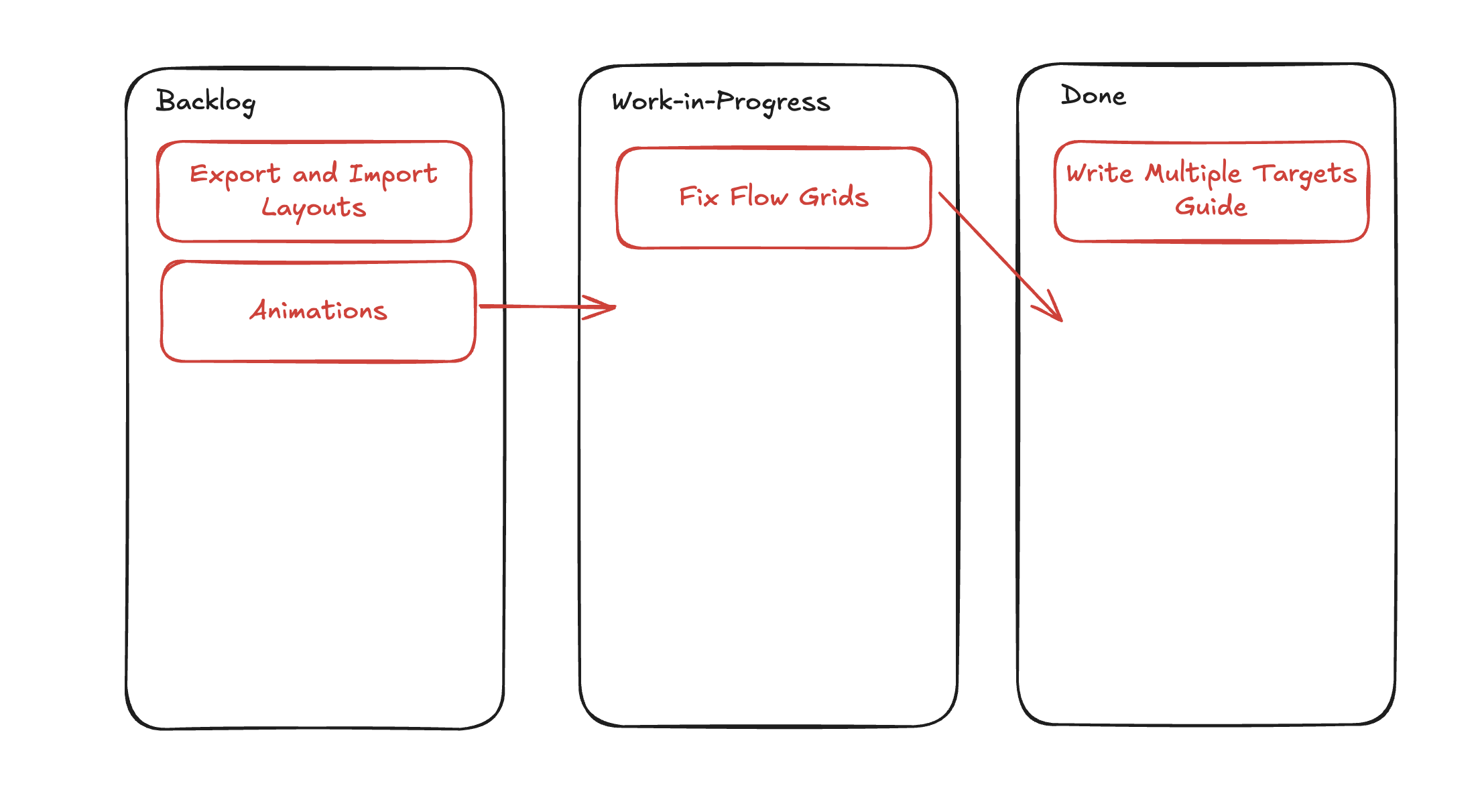
Here, one FlexiTarget for our Kanban board wouldn’t be enough, as we have three different Flow layouts to maintain. The board structure that Flexiboards supports (see Overview) lets us put multiple FlexiTargets within the same FlexiBoard.
Using multiple targets
To add a second target, create another FlexiTarget component inside of your FlexiBoard. Each FlexiTarget has its own configuration, so each target’s layout can behave differently from the others.
You can also use the targetDefaults property on the FlexiBoard configuration object if you want all targets to have consistent behaviour.
The example below builds the Kanban board we described earlier.
Backlog
Work-in-Progress
Done
<script>
import { FlexiBoard, FlexiTarget, FlexiWidget } from '@flexiboards/svelte';

const targetClass = 'w-64 lg:w-48 border rounded-md p-3 min-h-48 lg:min-h-72';
const gridClass = 'gap-2';
</script>

<FlexiBoard
config={{
targetDefaults: {
layout: {
type: 'flow',
flowAxis: 'row',
placementStrategy: 'append'
}
},
widgetDefaults: {
draggability: 'full',
className: (widget) => [
'bg-muted px-4 py-2 rounded-lg w-full text-base',
widget.isShadow && 'opacity-50',
widget.isGrabbed && 'animate-pulse opacity-50'
]
}
}}
class={'flex flex-col items-center gap-8 lg:flex-row lg:items-stretch lg:justify-center'}
>
<div class={targetClass}>
<h4 class="text-foreground mb-2 text-base font-semibold">Backlog</h4>
<FlexiTarget key={'backlog'} class={gridClass}>
<FlexiWidget>Export and Import Layouts</FlexiWidget>
<FlexiWidget>Animations</FlexiWidget>
</FlexiTarget>
</div>

<div class={targetClass}>
<h4 class="text-foreground mb-2 text-base font-semibold">Work-in-Progress</h4>
<FlexiTarget
key={'wip'}
class={gridClass}
config={{
layout: {
type: 'flow',
flowAxis: 'row',
placementStrategy: 'append',
maxFlowAxis: 2
}
}}
>
<FlexiWidget>Fix Flow Grids</FlexiWidget>
</FlexiTarget>
</div>

<div class={targetClass}>
<h4 class="text-foreground mb-2 text-base font-semibold">Done</h4>
<FlexiTarget key={'done'} class={gridClass}>
<FlexiWidget>Write Multiple Targets Guide</FlexiWidget>
</FlexiTarget>
</div>
</FlexiBoard>With the extra FlexiTarget components in place, we can drag and drop widgets within their current target, as well as drop them into the other two.
Advanced: mixing grids
So far, every target we’ve dragged between has been a Flow Grid. Dragging between a Flow Grid and a Free-Form Grid works the same way: Flexiboards applies the same drag-and-drop logic whatever grid type the target dropzone uses.
List Representation
Grid Representation
<script>
import { FlexiBoard, FlexiTarget, FlexiWidget } from '@flexiboards/svelte';

const targetClass = 'w-64 lg:w-48 border rounded-md p-3 min-h-48 lg:min-h-72';
const gridClass = 'gap-2';
</script>

<FlexiBoard
class={'flex flex-col items-center gap-8 lg:flex-row lg:items-stretch lg:justify-center'}
>
<div class={targetClass}>
<h4 class="text-foreground mb-2 text-base font-semibold">List Representation</h4>
<FlexiTarget
key={'flow'}
class={gridClass}
config={{
layout: {
type: 'flow',
flowAxis: 'row',
placementStrategy: 'append'
},
widgetDefaults: {
draggability: 'full',
className: (widget) => [
'bg-blue-700 text-white px-4 py-2 rounded-lg w-full text-base',
widget.isShadow && 'opacity-50',
widget.isGrabbed && 'animate-pulse opacity-50'
]
}
}}
>
<FlexiWidget>A</FlexiWidget>
<FlexiWidget>B</FlexiWidget>
</FlexiTarget>
</div>

<div class={targetClass}>
<h4 class="text-foreground mb-2 text-base font-semibold">Grid Representation</h4>
<FlexiTarget
key={'free'}
class={gridClass}
config={{
rowSizing: '4rem',
layout: {
type: 'free',
minRows: 2,
minColumns: 2,
maxRows: 2,
maxColumns: 2
},
widgetDefaults: {
className: 'bg-red-700 text-white px-4 py-2 rounded-lg text-base w-16'
}
}}
>
<FlexiWidget x={0} y={0}>C</FlexiWidget>
<FlexiWidget x={1} y={1} height={1}>D</FlexiWidget>
</FlexiTarget>
</div>
</FlexiBoard>Notice that when the widget switches between the two grids, its background colour changes to reflect the widgetDefaults of the grid it is in. That’s Cascading Configuration: the widget resolves each unspecified property from its nearest ancestor, and its nearest ancestor has changed.
Examples
The Notes example nests a Kanban board inside another board. Boards nest independently: a widget inside the inner board cannot be moved into the outer one.
Gotchas
- Flow grids reset the flow-axis size. A widget dragged from a free-form grid into a flow grid has its flow-axis dimension (height, for row flow) set to 1, and keeps that size if dragged back out. Store the original size in
metadataif you need to restore it. - Widgets cannot cross boards. Two
FlexiBoards on one page are separate drag-and-drop environments.